ClusterStratifiedKFold: cluster-stratified spatial CV
ClusterStratifiedKFold fits a user-supplied clusterer (HDBSCAN, OPTICS, KMeans, …)
to the input locations, then partitions each cluster’s members into n_splits parts.
Every test fold draws proportionally from every cluster, so each fold spans all clusters
rather than holding out a single region.
This is the spatial analogue of StratifiedKFold where the strata are spatial clusters
discovered at fit time.
import geodatasets
import geopandas
import numpy
import matplotlib.pyplot as plt
import colormaps
from sklearn.cluster import HDBSCAN
from sklearn.linear_model import LinearRegression
from sklearn.metrics import root_mean_squared_error

from geovalidate import ClusterStratifiedKFold
/Users/ljwolf/miniforge3/envs/analysis/lib/python3.14/site-packages/tqdm/auto.py:21: TqdmWarning: IProgress not found. Please update jupyter and ipywidgets. See https://ipywidgets.readthedocs.io/en/stable/user_install.html
  from .autonotebook import tqdm as notebook_tqdm
Data — King County house sales
We use a random subsample of 2 000 sales from the full King County dataset, projected to UTM 10N (metres) so that HDBSCAN operates on meaningful distance units.
gdf_full = geopandas.read_file(geodatasets.get_path("geoda.home_sales")).to_crs("EPSG:32610")
gdf_full["log_price"] = numpy.log(gdf_full["price"])

rng = numpy.random.default_rng(42)
idx = rng.choice(len(gdf_full), 2000, replace=False)
gdf = gdf_full.iloc[idx].reset_index(drop=True)
coords = numpy.column_stack([gdf.geometry.x, gdf.geometry.y])

print(f"n = {len(gdf)} sales  |  price ${gdf.price.min():,.0f} – ${gdf.price.max():,.0f}")
n = 2000 sales | price $95,000 – $3,635,000
Downloading file 'kingcounty.zip' from 'https://geodacenter.github.io/data-and-lab//data/kingcounty.zip' to '/Users/ljwolf/Library/Caches/geodatasets'.
Extracting 'kingcounty/kc_house.shp' from '/Users/ljwolf/Library/Caches/geodatasets/kingcounty.zip' to '/Users/ljwolf/Library/Caches/geodatasets/kingcounty.zip.unzip'
Extracting 'kingcounty/kc_house.dbf' from '/Users/ljwolf/Library/Caches/geodatasets/kingcounty.zip' to '/Users/ljwolf/Library/Caches/geodatasets/kingcounty.zip.unzip'
Extracting 'kingcounty/kc_house.shx' from '/Users/ljwolf/Library/Caches/geodatasets/kingcounty.zip' to '/Users/ljwolf/Library/Caches/geodatasets/kingcounty.zip.unzip'
Extracting 'kingcounty/kc_house.prj' from '/Users/ljwolf/Library/Caches/geodatasets/kingcounty.zip' to '/Users/ljwolf/Library/Caches/geodatasets/kingcounty.zip.unzip'
Basic usage
Pass any sklearn-compatible clusterer. ClusterStratifiedKFold clones it internally,
fits to the input coordinates, then stratifies each cluster across folds.
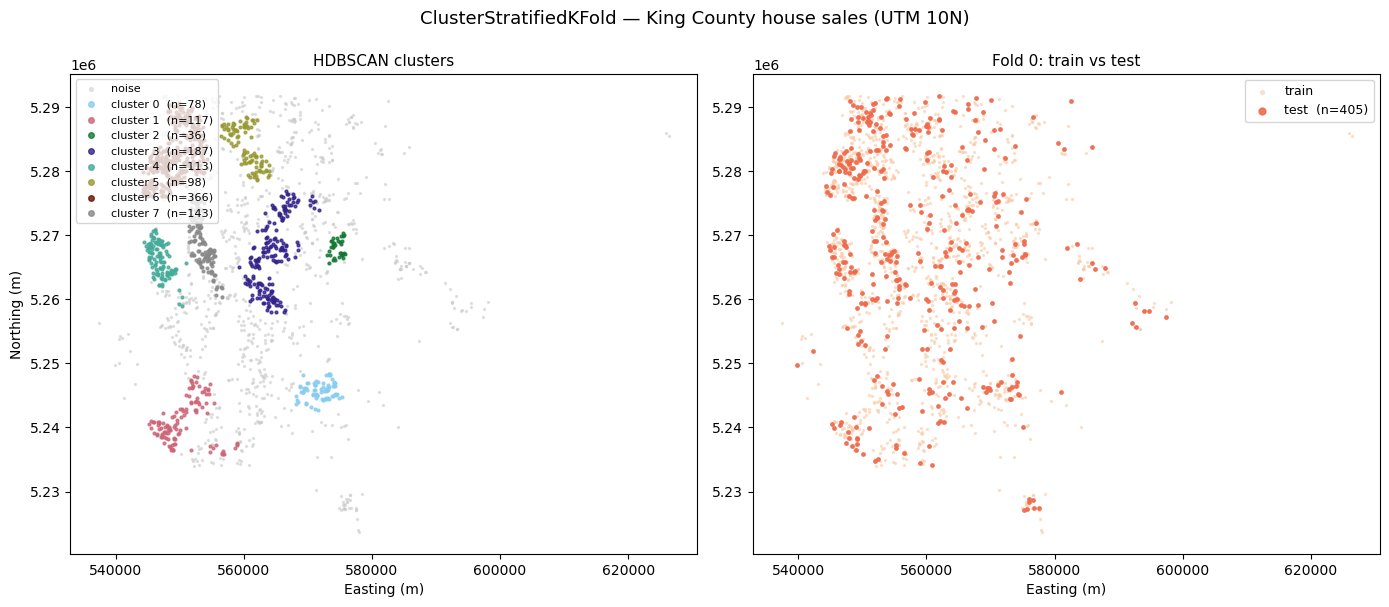
HDBSCAN(min_cluster_size=30) finds the dense sub-regions of King County
(Seattle core, Bellevue/Eastside, suburban corridors) and labels sparse rural
points as noise (label = -1).
ckf = ClusterStratifiedKFold(
    HDBSCAN(min_cluster_size=30, copy=True),
    n_splits=5,
    random_state=0,
)
splits = list(ckf.split(gdf))

clusters = sorted(set(ckf.labels_) - {-1})
n_noise = int((ckf.labels_ == -1).sum())
print(f"discovered {ckf.n_clusters_} clusters  |  noise points: {n_noise} ({n_noise/len(gdf):.0%})")
print(f"cluster sizes: {sorted([(ckf.labels_==c).sum() for c in clusters], reverse=True)}")
print(f"fold sizes:    {[len(te) for _, te in splits]}")
discovered 9 clusters  |  noise points: 862 (43%)
cluster sizes: [np.int64(366), np.int64(187), np.int64(143), np.int64(117), np.int64(113), np.int64(98), np.int64(78), np.int64(36)]
fold sizes:    [405, 403, 400, 396, 396]
Visualize clusters and one example fold
Left: HDBSCAN clusters (noise in grey). Right: train vs test assignment for fold 0. Notice that the test points (orange) are spread across all clusters — not concentrated in a single geographic region.
gdf["cluster"] = ckf.labels_

fold0_train, fold0_test = splits[0]
role = numpy.full(len(gdf), "train", dtype=object)
role[fold0_test] = "test"
gdf["fold0_role"] = role

fig, axes = plt.subplots(1, 2, figsize=(14, 6))

# Panel 1: cluster map
ax = axes[0]
gdf[gdf.cluster == -1].plot(ax=ax, color="#ccc", markersize=2, alpha=0.5, label="noise")
for fi, c in enumerate(clusters):
    sub = gdf[gdf.cluster == c]
    sub.plot(ax=ax, color=colormaps.safe(fi / max(len(clusters) - 1, 1)),
             markersize=4, alpha=0.8, label=f"cluster {c}  (n={len(sub)})")
ax.set_title("HDBSCAN clusters", fontsize=11)
ax.set_xlabel("Easting (m)"); ax.set_ylabel("Northing (m)")
ax.set_aspect("equal")
ax.legend(fontsize=8, markerscale=2, loc="upper left")

# Panel 2: fold 0 train / test
ax2 = axes[1]
gdf[gdf.fold0_role == "train"].plot(ax=ax2, color=colormaps.peach(0.2),
                                    markersize=2, alpha=0.5, label="train")
gdf[gdf.fold0_role == "test"].plot(ax=ax2, color=colormaps.peach(0.8),
                                   markersize=6, alpha=0.9, label=f"test  (n={len(fold0_test)})")
ax2.set_title("Fold 0: train vs test", fontsize=11)
ax2.set_xlabel("Easting (m)")
ax2.set_aspect("equal")
ax2.legend(fontsize=9, markerscale=2)

fig.suptitle("ClusterStratifiedKFold — King County house sales (UTM 10N)", fontsize=13)
fig.tight_layout()
plt.show()
Noise handling
Density-based clusterers (HDBSCAN, OPTICS) label outlier points with -1.
ClusterStratifiedKFold exposes four policies:
noise='stratify'(default): distribute noise across folds like any other cluster.noise='drop': exclude noise from both train and test.noise='train_only': noise is in every train set, never in any test set.noise='nearest': each noise point is reassigned to the cluster of its nearest non-noise neighbour and then participates in that cluster’s fold-assignment pool as a regular member.
noise_idx = numpy.flatnonzero(ckf.labels_ == -1)

for mode in ("stratify", "drop", "train_only", "nearest"):
    ckf_m = ClusterStratifiedKFold(
        HDBSCAN(min_cluster_size=30, copy=True),
        n_splits=5, noise=mode, random_state=0,
    )
    splits_m = list(ckf_m.split(gdf))
    train0, test0 = splits_m[0]
    train_noise = int(numpy.isin(noise_idx, train0).sum())
    test_noise  = int(numpy.isin(noise_idx, test0).sum())
    fold_sizes  = [len(te) for _, te in splits_m]
    print(
        f"noise={mode:11s}  "
        f"fold0 train noise={train_noise:3d}, test noise={test_noise:3d}  "
        f"fold sizes={fold_sizes}"
    )
noise=stratify     fold0 train noise=689, test noise=173  fold sizes=[405, 403, 400, 396, 396]
noise=drop         fold0 train noise=  0, test noise=  0  fold sizes=[232, 230, 228, 224, 224]
noise=train_only   fold0 train noise=862, test noise=  0  fold sizes=[232, 230, 228, 224, 224]
noise=nearest      fold0 train noise=707, test noise=155  fold sizes=[404, 401, 400, 399, 396]
Pre-fitted clusterer
If you have already fit a clusterer (e.g. to inspect it, tune it, or share it across
folds and other code), pass it in directly: ClusterStratifiedKFold will detect the
labels_ attribute and skip refitting.
fitted = HDBSCAN(min_cluster_size=30, copy=True).fit(coords)
print(f"pre-fit found {len(set(fitted.labels_) - {-1})} clusters")

ckf_pre = ClusterStratifiedKFold(fitted, n_splits=5, random_state=0)
splits_pre = list(ckf_pre.split(gdf))

assert ckf_pre.clusterer_ is fitted, "pre-fitted clusterer should be used as-is"
print(f"fold sizes: {[len(te) for _, te in splits_pre]}")
pre-fit found 8 clusters
fold sizes: [405, 403, 400, 396, 396]
Cross-validation example
Predict log(price) from structural features. Because each fold’s test set spans all geographic clusters, fold-to-fold RMSE variance reflects model generalisation rather than spatial coverage differences.
feat_cols = ["sqft_liv", "bedrooms", "bathrooms", "grade"]
y = gdf["log_price"].values
X = gdf[feat_cols].fillna(0).values

rmse_per_fold = []
for train, test in splits:
    lr = LinearRegression().fit(X[train], y[train])
    rmse_per_fold.append(root_mean_squared_error(y[test], lr.predict(X[test])))

print(f"RMSE per fold: {[f'{r:.3f}' for r in rmse_per_fold]}")
print(f"mean RMSE: {numpy.mean(rmse_per_fold):.3f}  ±  {numpy.std(rmse_per_fold):.3f}")
RMSE per fold: ['0.328', '0.356', '0.367', '0.343', '0.357']
mean RMSE: 0.350  ±  0.014